Showing posts with label In the garden. Show all posts

Monday, 15 September 2014

spring's simple pleasures


Leah -  I've been up north in our home town Bellingen for the past three weeks and the other day I got a call from Summer to say that our broccoli had sprouted divine little broccoli heads - we proceeded to make high pitch noises and jump in excitement! I have to say I'm almost missing our garden as much I'm missing the people in it. 

Summer- I have in fact being doing a lot of excited squeaks and flapping of arms. I blame the intoxicating feeling of spring's first warm days and the chance to be outside again without five different woolen layers. The turning of the seasons is one of my favorite things to witness. The transition times that gently remind us to look about and notice what is going on around us. The Lorrikeets' return to the garden made me stop what I was doing and soon I was discovering the first of the jasmine tumbling over the fence. Its a time that seems to invite reflection, watching the subtle changes in our surroundings that happen day by day without much fuss to shift into the next period of growth. Its quite amazing watching people's reaction to the change, people shaking out the winter stillness and beginning to initiate new ideas and actions that have been sprouting in our minds over cozy fires and shared winter soups, and letting old stuff go in the process. I'm actually in the middle of packing up the house and will be saying good bye to our little garden and home that's been our little center of creativity. So there will be no spring planting to continue this time, which makes me a bit sad,  but each day I have a satisfying sense of abundance as I harvest the broccoli and kale, beans, carrot and silver beet, and think of spreading the compost over the beds before I leave to nourish the soil that has fed us for the last 4 months. 


Wednesday, 30 July 2014

House of the worms

After a couple of weeks, we began to realise that even with our wizz-bang compost, we still had green waste coming out our ears. We began to look for another source to process our scraps, to avoid overwhelming the micro-organisms of the compost and ending up simply with a smelly rotting food pile. And so we decided to try our hand at worm farming.
We had the novel experience of buying a pack of worms off the shelf at CERES to bring home. Creating the worm house/palace/temple/abode took a surprisingly short amount of effort and time, and after one delicious autumn afternoon's work we were tucking the new family members into their composty bed.  They are the worlds easiest/cheapest pets, content to simply live in the corner of the garden munching on our kitchen scraps, although they may kick up a fuss if asked to eat citrus, meat, onions or teabags. You may not receive the same amount of emotional devotion as from your fluffy animal friends, but these guys are a very efficient addition to the household. Watering the veggies with some of their juice or fertilising the newly planted seedlings with some of their castings is overwhelmingly satisfying.

House of the Worms Construction Guide

Materials used: 2 styrofoam boxes and lid
                         1 hessian sack
                         A block of peat compost (or some other equivalent)
                         500-1000 worms (depending on amount of green waste produced)
                         Damp newspaper.

First we punched holes (5cent diameter or slightly smaller) into the base of one of the boxes. This will sit on top of the second box and is where the worms will live. We lined the base of this box with the hessian sack, then filled it with the peat compost and worms. The holes allow the worm juice to drain into the lower box, while the hessian sack stops the worms and soil from falling through. The damp newspaper was laid over the top to help keep the worms warm. The lower box has one slightly larger hole in the base to drain the fluid. Place a bucket under here to catch the worm juice!


Saturday, 19 July 2014

Comunity Gardens

I work and volunteer at an amazing midwifery clinic called MAMA (Midwives and Mothers Australia) and recently Summer and I got to work setting up a community herb garden that clients and midwives can use to make up medicinal teas for anything from oversupply of milk to upset stomachs.  

Someone before us had already started by making big wicking beds out of old pallets so we begun by topping them up with some compost and soil.Wicking beds, put simply are garden beds that have a waterproof lining which holds a reservoir of water that is drawn up to the surface of the bed. They are perfect for places like Melbourne where the Summers a hot and dry and water evaporates really quickly.

From http://www.urbanfoodgarden.org/main/wicking-beds/wicking-beds.htm


And in went the herbs. Goat's rue (Galega officinalis) and fennel which can be helpful to increse milk supply, Spearmint helpful for decreasing milk supply and many other wonderful herbs.

-A little side note from Summer - The first time I heard of a midwife, it was as a healer woman in historical communities. Supporting women during their birthing being only part of their role, along with nurturing people using their knowledge of the plants and other resources about them. I was quite young at the time, and thought this title sounded a bit like some kind of awesome witch. My view of midwifery has obviously changed quite a bit as I've got older, but planting these herbs took me back to my first discovery of midwives as care givers. It was a perfect balance to the healthcare system we both are now studying in, to be learning about an older knowledge base, that utilises and integrates the natural resources aroud us into our health.


The next few photo's are from a permablitz at a local community garden where we got stuck into weeding and winter pruning in the food forest, shared a delicious meal and went to a great composting workshop.
It was a cold but beautiful day of sharing of knowledge, skills and inspiration. It was really great to connect up with other people that have an incredible wealth of knowledge about growing food in our area.


Leah.


Tuesday, 8 July 2014

compost delights

Living in a house with six people, we create a lot of green waste. Lacking any alternative, these wonderful scraps full of nutrients were being thrown out in plastic bags instead of feeding our new little veggie garden. What a waste! And so the creation of the compost began!
Buckets of dandelion leaves were gathered from our wild back yard, and cow poo from Leah's permaculture friends. Old autumn leaves and a bundle of hay.

The idea is to layer the compost like a lasagna, alternating between nitrogen substances and carbon in order to get the right ratio for decomposition, with a little bit of soil or compost in-between.
So first, we lay damp cardboard down, then on top placed our structure made of chicken wire to keep everything nice and tidy.
Then went the first carbon layer - a combination of straw, leaves and twigs from the backyard.
This was followed by some ready- made compost, then the nitrogen layer of fresh and green dandelion leaves and cow manure.
Then another carbon layer.
The next part was to compress it all by mashing it down with a thick piece of wood, a bit like a giant mortar and pestle. This makes sure there are no air pockets.
This patten continues until the are a few layers to the lasagna.


A beautiful Lasagne Compost! Unfortunately I didn't get any photo's of our creation so I nicked this from someone else, but ours looked very similar to this beauty.

We let it settle for a few days then started to add the kitchen scraps, yippee!

A few weeks on it's giving off heat which means there are lots of happy little microorganisms. Each time we add some greens we sprinkle it with a handful of mulch and let the compost work its magic. This is our very first compost, so it is still a learning experience for us, but so far so good!

Summer.


Monday, 7 July 2014

A forest of food

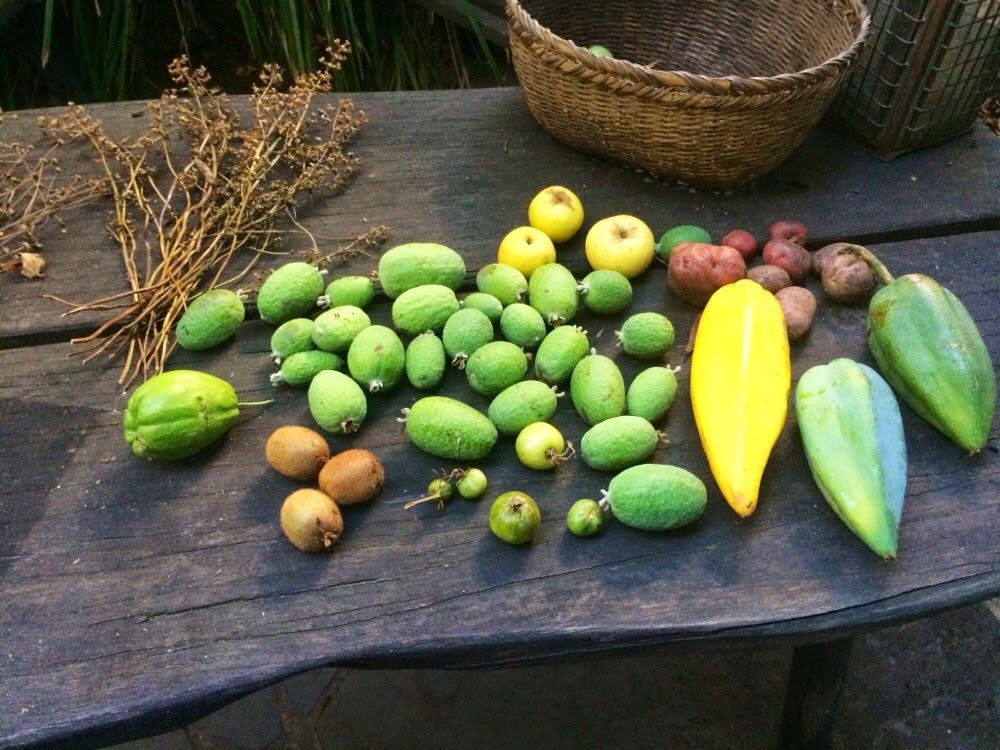
Last Saturday I met up with my permaculture class at Karen Sutherand's beautiful home in Pascoe Vale. Karen has, over 25 years, turned her garden into an edible forest. We wandered around her garden picking kiwi fruit from vines, cherry guavas of small bushes and sucking the flesh of feijoas.

 Karen has converted her shed roof into a rooftop garden where she keeps her bees and grows strawberries, has turned the nature strip outside her house into a community garden, the majority of her garden is watered using grey water and she has an aquaponics system worth drooling over.

Walking around Karen's garden and seeing the incredible abundance of winter produce was so inspiring. Putting your hands in the soil and being aware of how, where and in what season something grows is the most simple, beautiful way to reconnect to ourselves and to the land. 

An array of fruits from the winter garden.


Geodesic dome chicken tractor!


I've just found this TED talk and found it so inspiring and a perfect addition to this post.

Leah


Saturday, 14 June 2014

the winter planting

With the cooler weather well and truly settled in, its time to be planting the winter veggies. We've got little broccoli, carrots, beans, cabbage, kale, asparagus and chive seedings now tucked in among the rocket leaves, silver beet and herbs. Our beetroot is looking luscious and will be soon ready to pull up for eating! Our sprouting trays are also active, with tiny peas, pak choy and rainbow chard seedlings poking up through the soil. 
Winter is a quiet time and I've often associated it with being dormant and restful. A time of dying back and bare branches. Harvest time is over and there is a resting of the soil. Walking around our garden and watching all the growth I've realised its not necessarily so and it can be quite an abundant season. Tomorrow's the winter solstice and our little garden has been a beautiful reminder of the importance of the seasons. 


For the peas we made trellises out of sticks collected from the garden. 


A shack for the seedlings :)
One of our favourite things about this garden has been watering it each day and taking the time out to wander around the garden and see the changes happening.  Going out to the seedlings each day is especially rewarding. I'll never get tired of watching seedlings pop up!


Summer :)


Friday, 13 June 2014

the spiral garden


This is the herb spiral I made after thinking about sacred geometry and the symbolism of the spiral. I thought it would be beautiful to have a garden in the shape of a spiral. Herb spirals are a popular permaculture design that maximise space and allow you to create varying microclimates for different plants. The plants that are higher up have better drainage and require dryer soils where as the ones lower down, such as spearmint, enjoy damper soil.
I loved collecting our veggies and herbs from the spiral, although the chickens worked hard teaching me the nature of impermanence as they were constantly getting in there and removing everything!

For more information here's a link I used http://littlemountainhaven.com/how-to-build-a-herb-spiral/


 First I put down cardboard boxes that had been soaked for a couple of hours over the area. This suppresses the weeds.
Next I placed the bricks in the spiral design, building them up in order to gradually raise the layers. I then placed some gravel in the centre to allow for better drainage.


Then I topped up the spiral with soil.


and planted away. 


Leah :)